
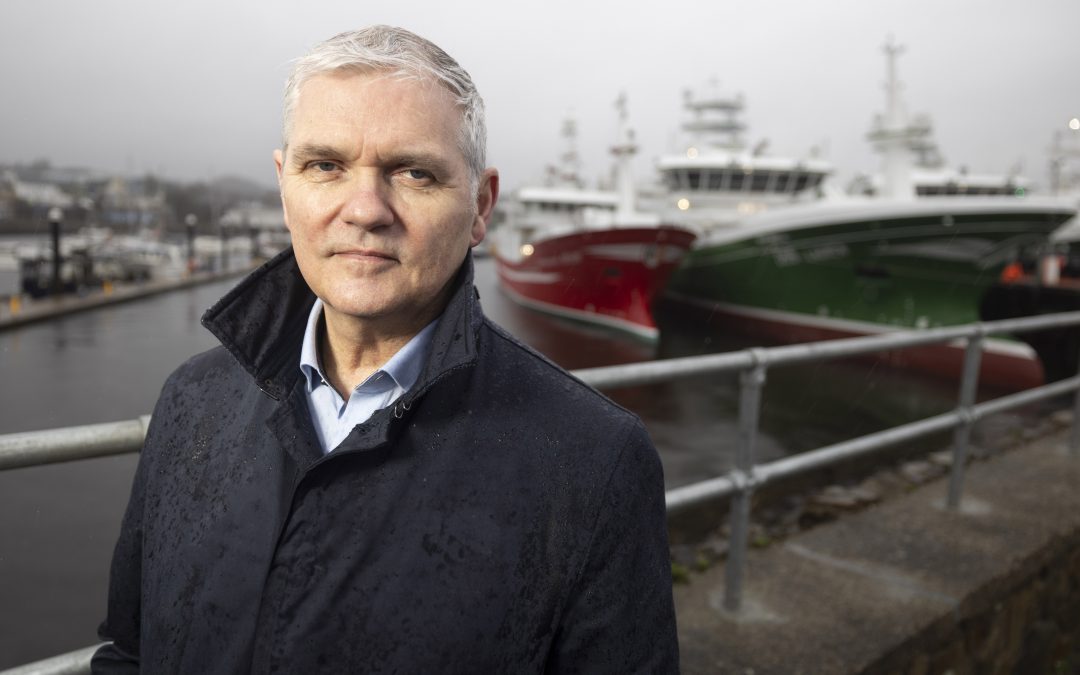
The Irish Fish Producers Organisation (IFPO) has called on the Government to seek a comprehensive review of Ireland’s position within the EU’s Common Fisheries Policy (CFP), after Iceland’s rejection of a return to EU accession talks exposed the extent to which Brussels was prepared to bend on fisheries to keep Iceland at the table.
Icelanders voted this week against reopening EU accession negotiations, frozen since 2013. In the lead-up to the vote, EU fisheries commissioner Costas Kadis and enlargement commissioner Marta Kos had both indicated there was scope for flexibility on CFP rules to accommodate Iceland’s fisheries and agriculture sectors; flexibility successive Irish governments have been told does not exist.
IFPO CEO Aodh O’Donnell said the result showed that Brussels’ room for manoeuvre on fisheries expands considerably when a country is prepared to hold its position.
“If the European Commission was ready to accept that the CFP cannot work for Iceland, then it must also acknowledge that the CFP is not working for Ireland,” O’Donnell said.
O’Donnell said Iceland had held firm on fisheries control throughout, and that Brussels’ willingness to offer concessions, (even to a country that went on to reject the talks altogether), said as much about the strength of that argument as it did about Iceland’s leverage. He said Irish fishing communities had been making the same case for years, without the same hearing.
O’Donnell said the contrast would not be lost on Irish fishing communities: “Irish fishermen have spent years being told the CFP is fixed and quota shares cannot move, through Brexit-driven losses, further quota reductions, fleet decommissioning, and the EU’s failure to deliver on the long-standing Hague Preferences mechanism. That Brussels found flexibility for a country not yet inside the EU sits awkwardly against that record.”
“Our fleet has endured repeated sacrifices in the name of European solidarity,” O’Donnell said. “We cannot accept a situation where Ireland continues to absorb losses while a country outside the EU is offered protections that have never been extended to existing member states.”
Setting standards in Brussels
The IFPO warned that Brussels’ approach to Iceland would set a precedent with implications across European fisheries policy. If geography, dependence on fisheries and unique marine resources were enough to justify special arrangements for Iceland, the organisation argues, the same case applies to Ireland.
The IFPO is calling on the Government to seek equivalent derogations for Ireland. This must include a rebalancing of the disproportionate Brexit settlement, under which Ireland contributed 40% of the total value of fish transferred to the UK under the Trade and Cooperation Agreement (TCA). There must also be a renewed focus on achieving a fair share and restoring greater national control underpinned by more effective management of Irish fisheries. This is essential to support coastal communities and secure a fairer, sustainable share of the wealth generated from Irish waters.
“We acknowledge and respect the steps taken by Iceland to maintain sovereignty and control over its natural resources,“ said Aodh O’Donnell. “While the EU may have failed in this instance, it must now move urgently to secure Iceland’s cooperation in a comprehensive coastal sharing agreement for our shared mackerel stocks, and to address the longstanding practice of self-allocating inflated shares of this shared resource.”
“There cannot be one set of rules for a country outside the EU and another for Ireland,” O’Donnell added. “If Europe was prepared to recognise that the CFP does not fit Iceland, then it is time to recognise that it has also failed many Irish fishing communities.”